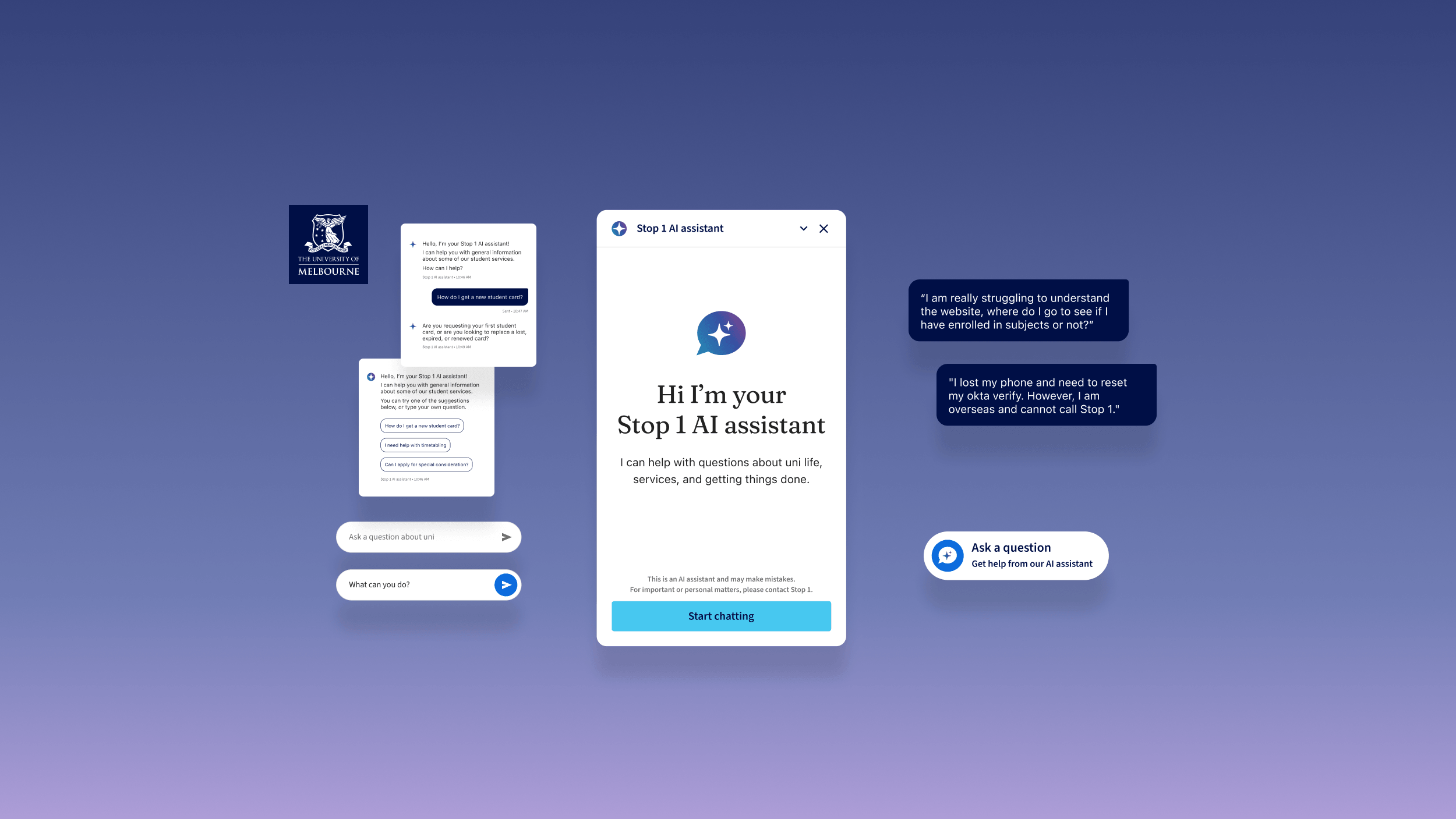
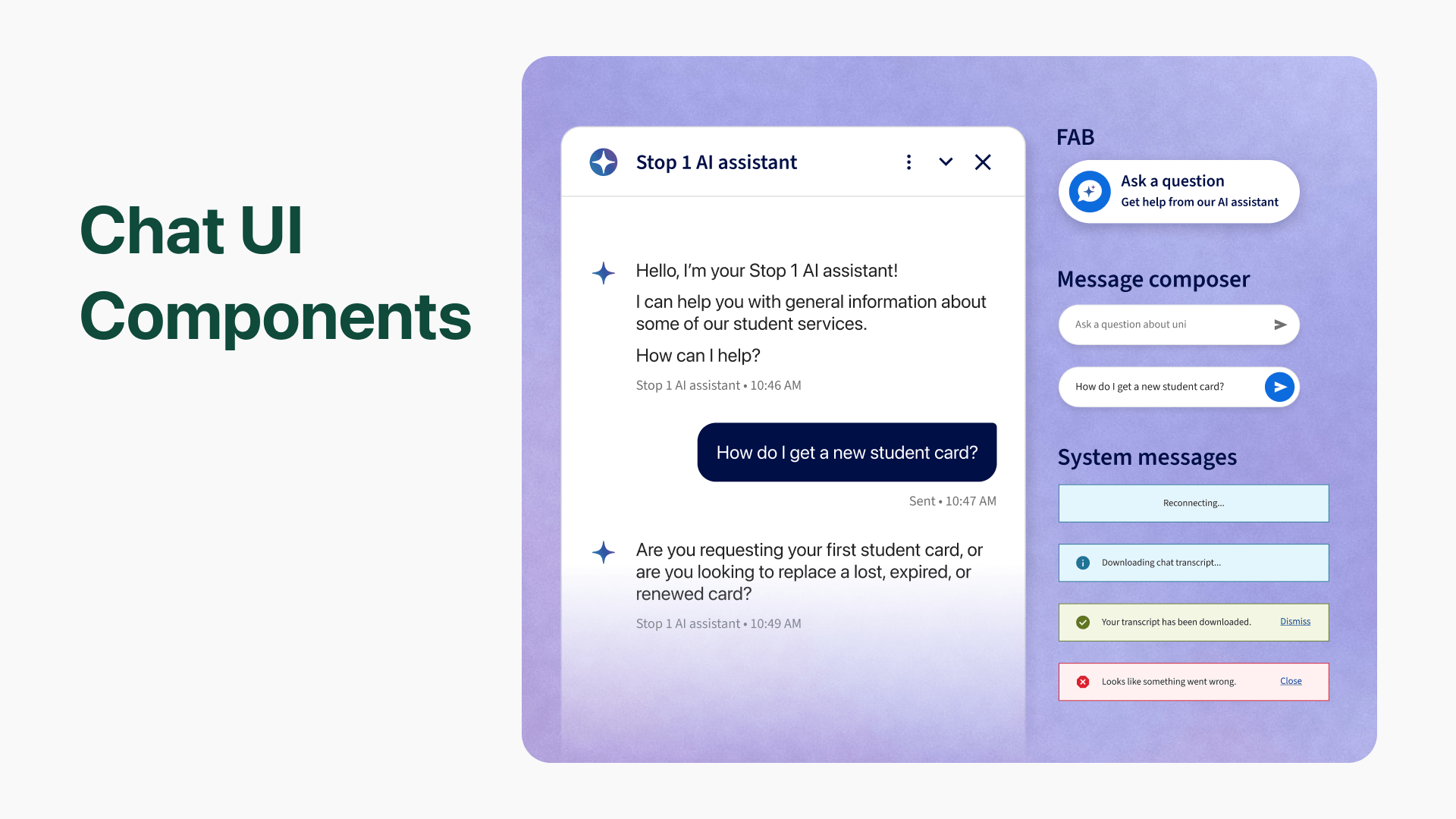
AI Student Support Channel
Designing an AI-powered student support experience, from service strategy and research through to launch and continuous optimisation.
Client:
University of Melbourne
My Role:
Senior Experience Design Lead
Service Strategy
Experience Design
AI Research & Optimisation
Our challenge
The University of Melbourne wanted to introduce an AI-powered support channel to help students resolve straightforward enquiries themselves, easing pressure on support teams.
The challenge was to create a useful, trustworthy experience while understanding where AI could help, when students needed human support, and how the channel could evolve within the University's broader student support experience.
Key goals
Define the role of AI within the University's student support ecosystem.
Create a useful, trustworthy self-service experience for students.
Identify and prioritise future capabilities through student research and experimentation.
Establish a phased roadmap for the service's evolution.
Develop an approach to continuous improvement using real student conversations and feedback.
My role
I led design across the initiative, from discovery through to launch and optimisation, owning the service journey, conversation design, guardrails and key design decisions for the AI assistant.
I line-managed up to five designers and worked closely with a tech lead, business analysts, testers and Student Services Operations. I also contributed to the roadmap alongside the initiative lead.
Key responsibilities:
Shaped the service direction and student experience.
Led service blueprinting, journey mapping and research.
Explored and validated future capabilities with students.
Contributed to the University's broader channel strategy.
Led and mentored designers, and facilitated stakeholder alignment.
Developed AI-assisted workflows for research and service optimisation.
Established an AI-assisted approach to analysing student conversations and translating insights into service improvements.
Defining the service
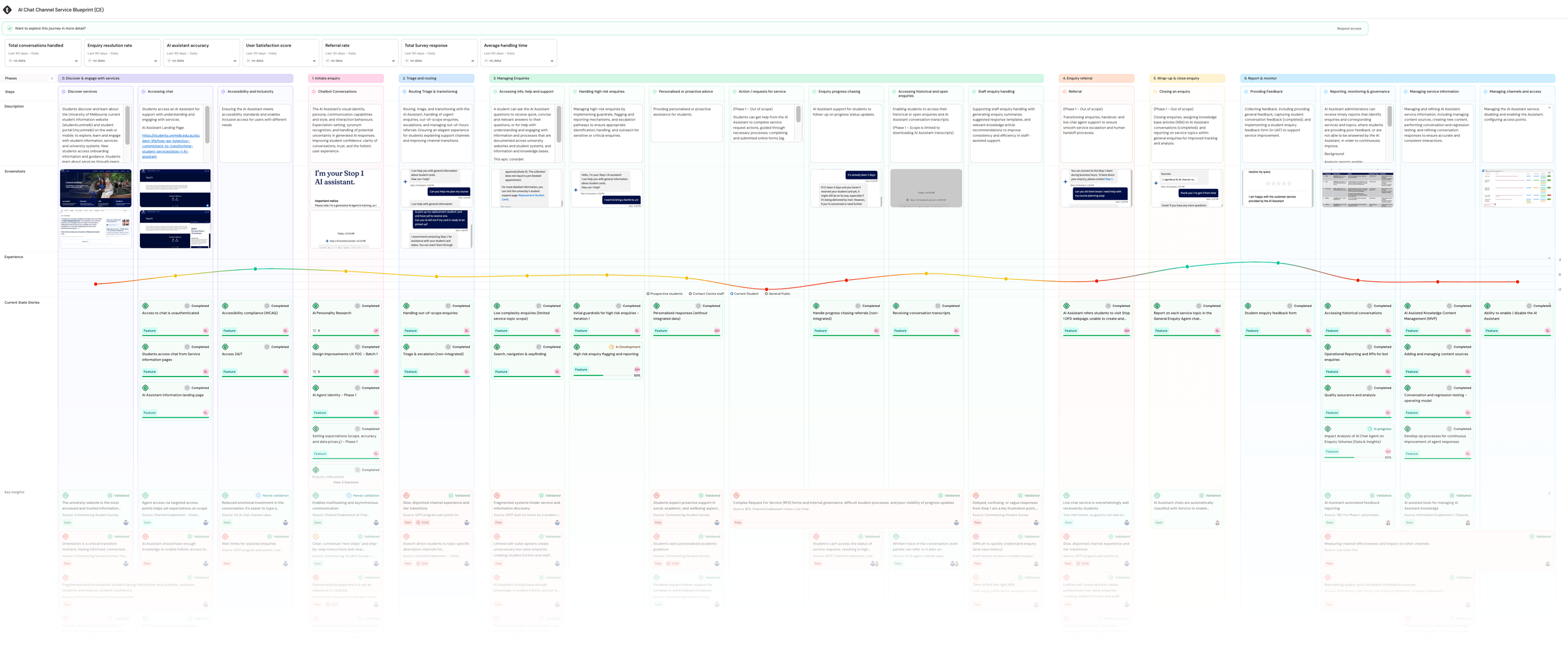
We created a service blueprint and journey map to bring together research insights, student pain points and opportunities across the wider support experience.
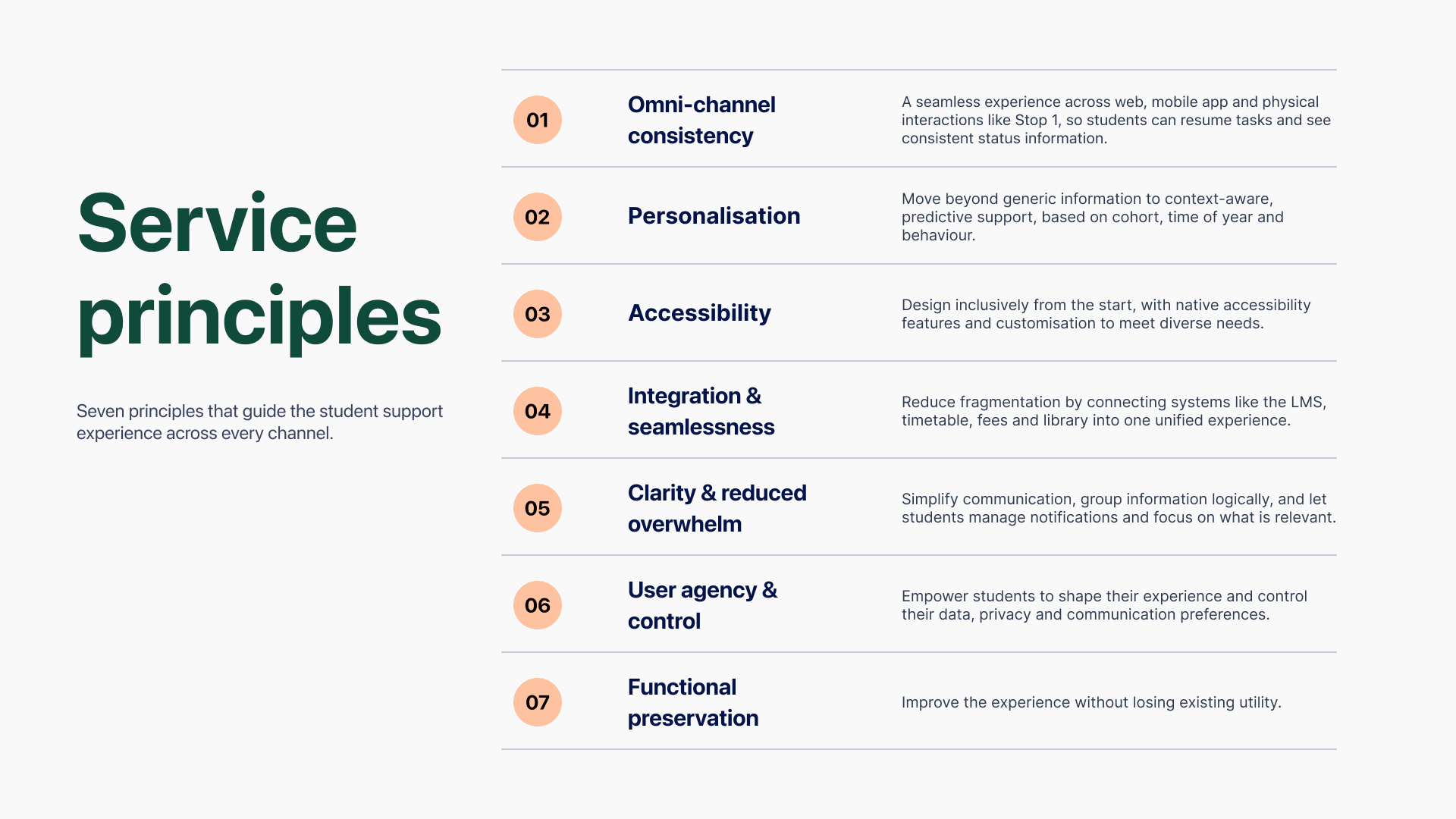
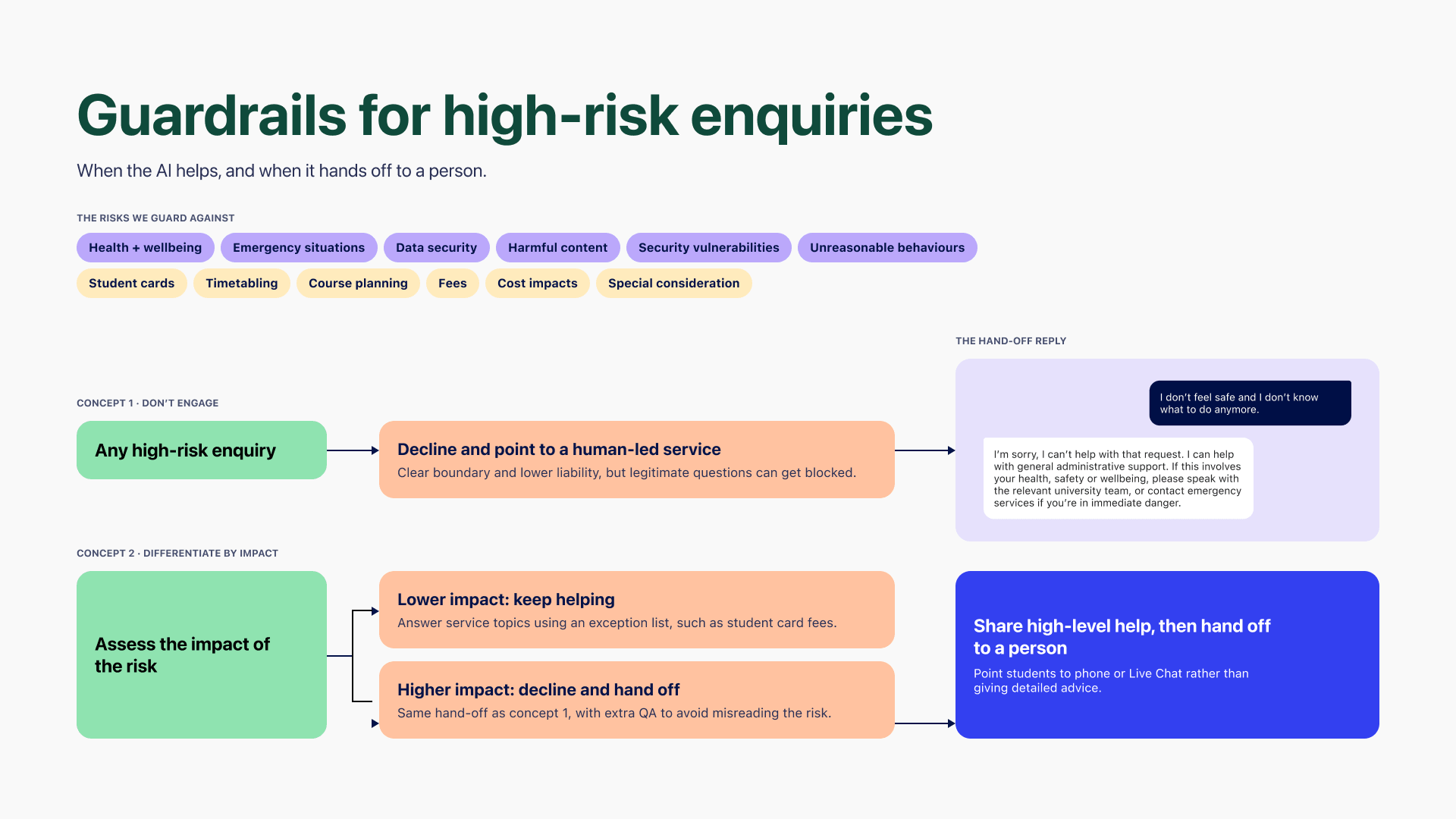
I helped establish design principles and guardrails for the AI, considering student needs, cultural backgrounds, accessibility, privacy and security, and the circumstances in which students might seek help. This included recognising that students could be using the service in moments of urgency, stress or vulnerability, and defining when the AI should provide support or direct them to other channels.
A phased capability roadmap helped stakeholders prioritise opportunities and guide the service's development. The journey map became a living artefact, evolving alongside our research and informing decisions as the technology and our understanding of student needs changed.
Exploring the Future State
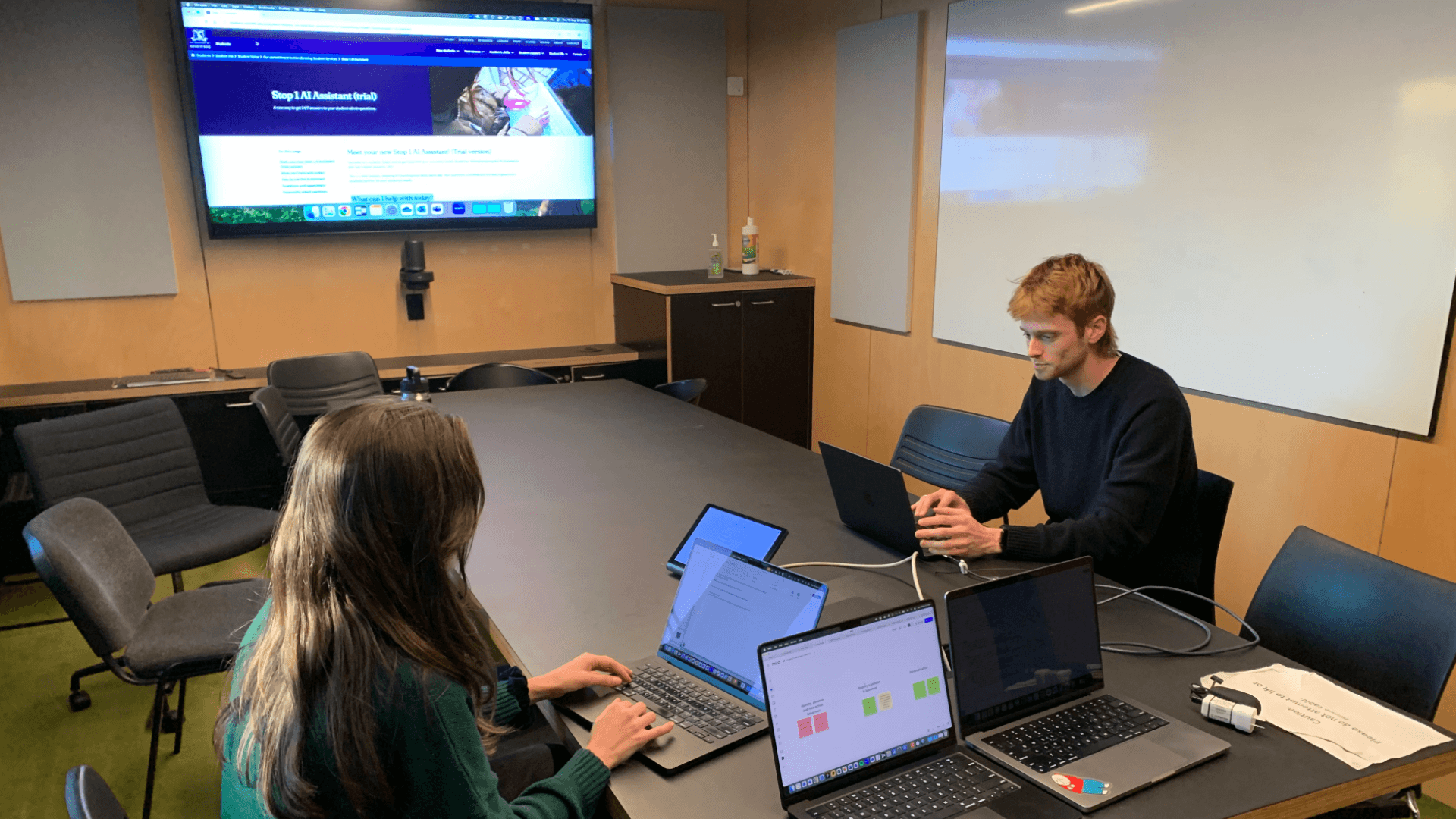
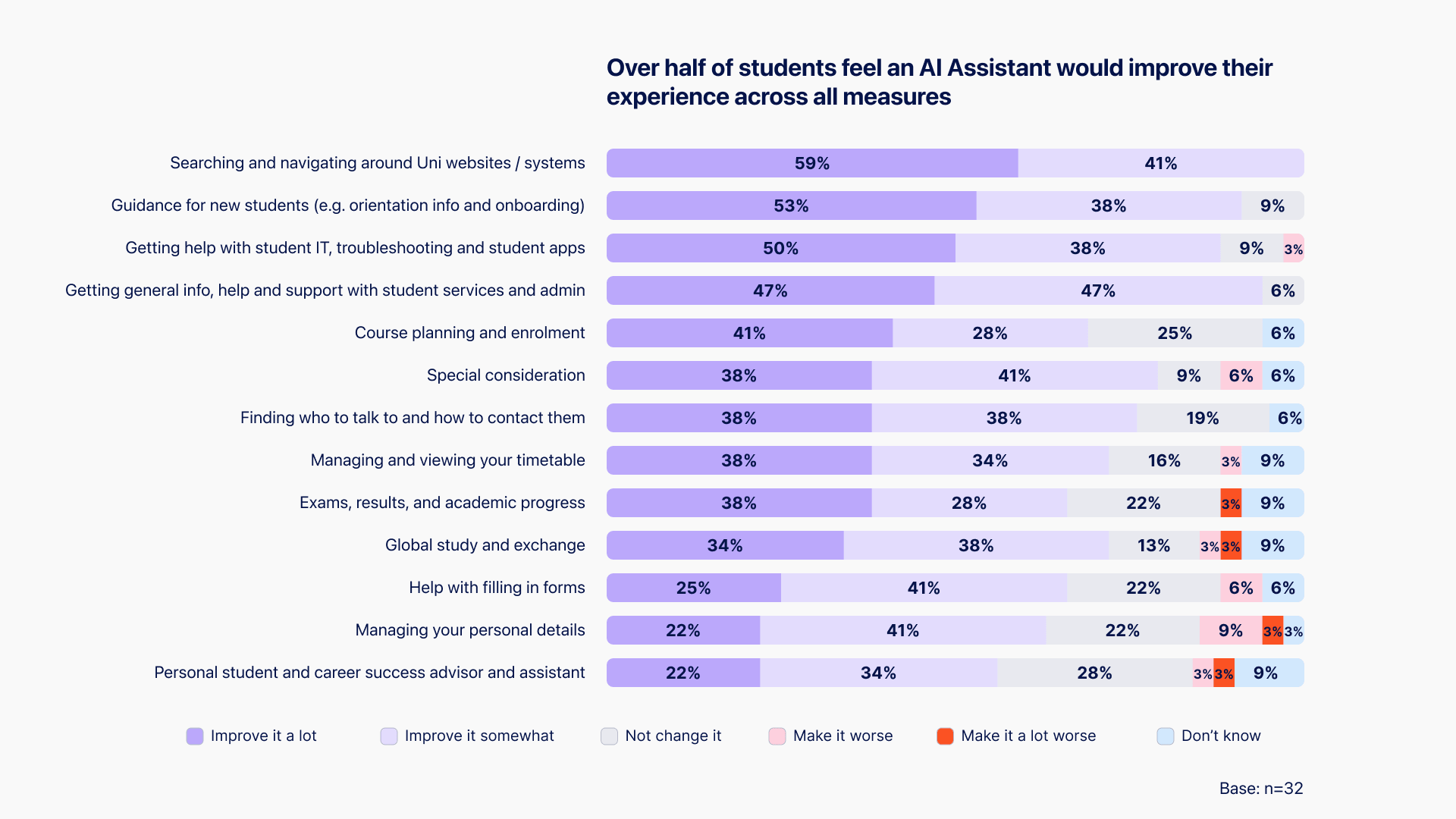
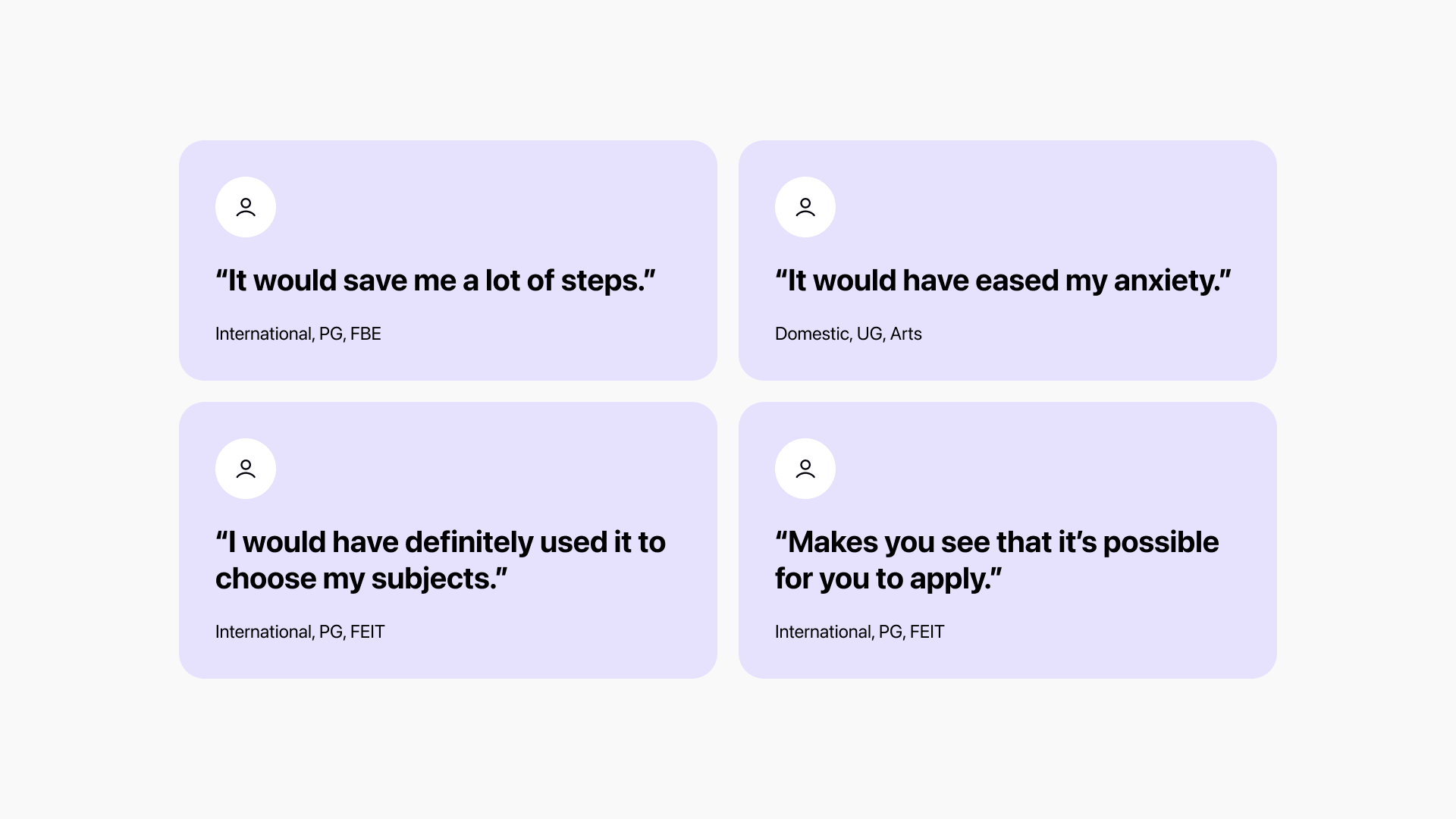
We explored potential future-state capabilities through rapid prototyping and experimentation, working with the research team to test concepts with students through moderated and unmoderated research.
This helped us validate opportunities, understand student needs and prioritise capabilities for future development.
Investigating conversational behaviour
We investigated how the AI assistant's conversational behaviour could influence enquiry resolution and reduce demand on support teams.
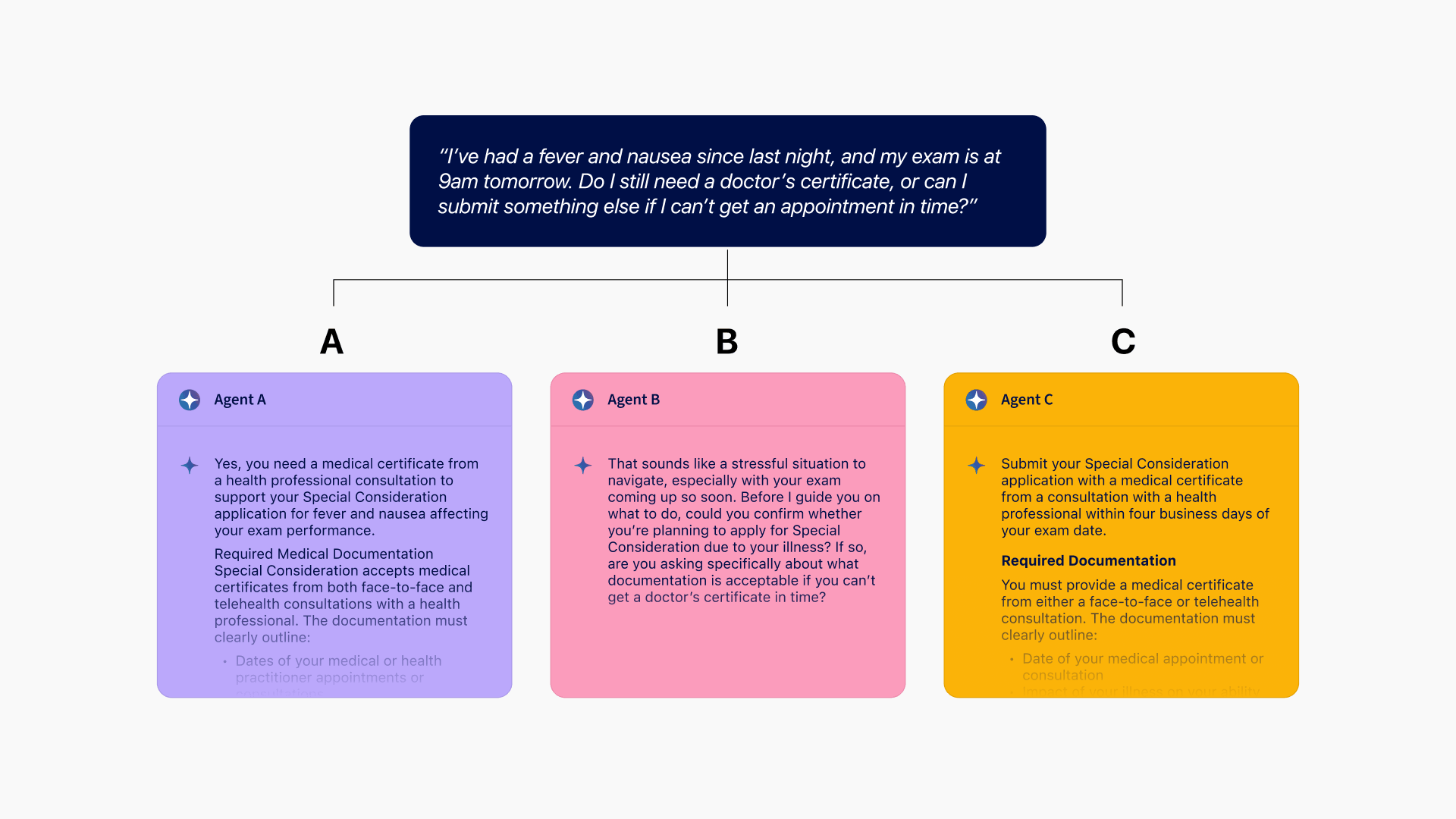
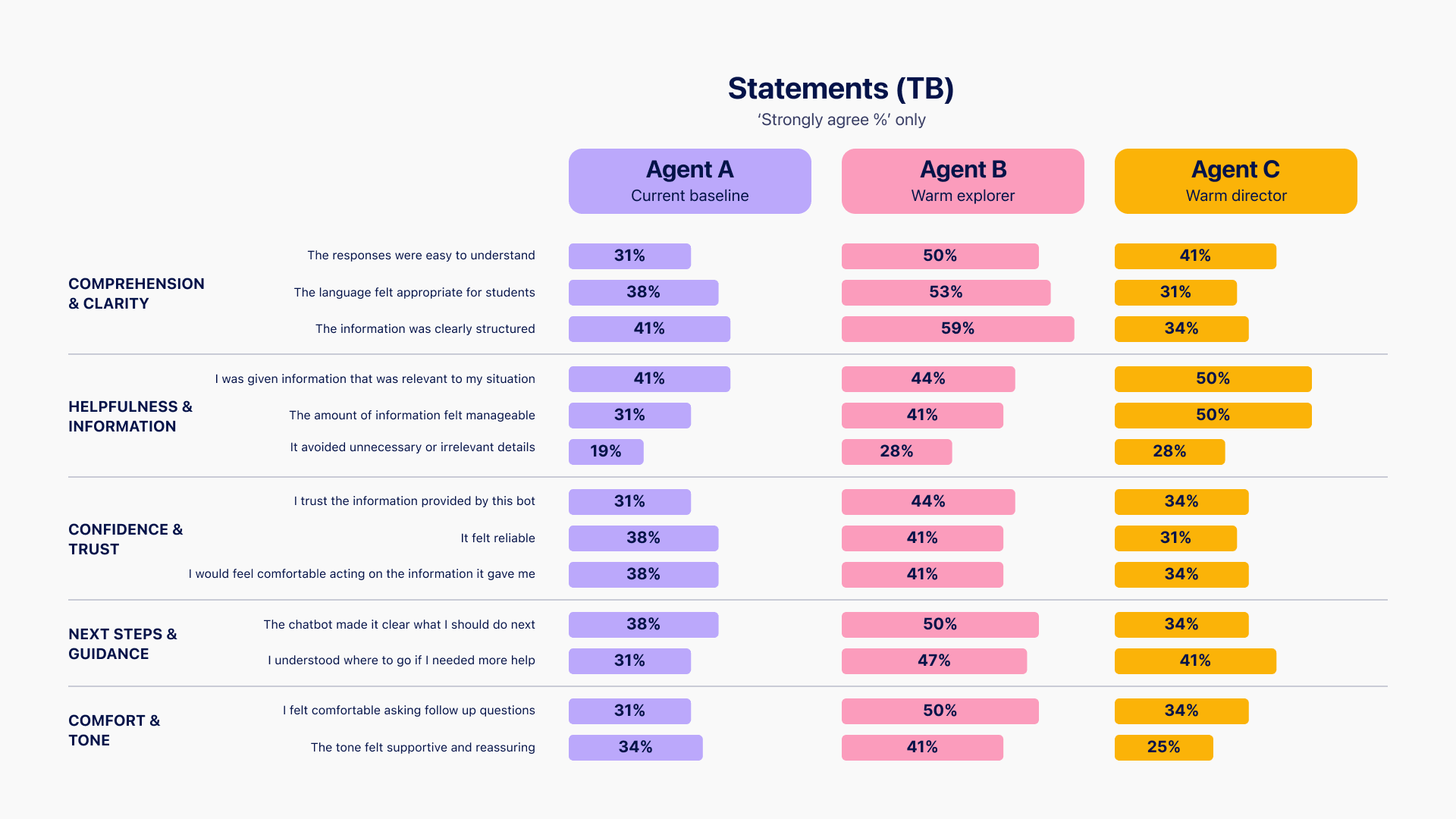
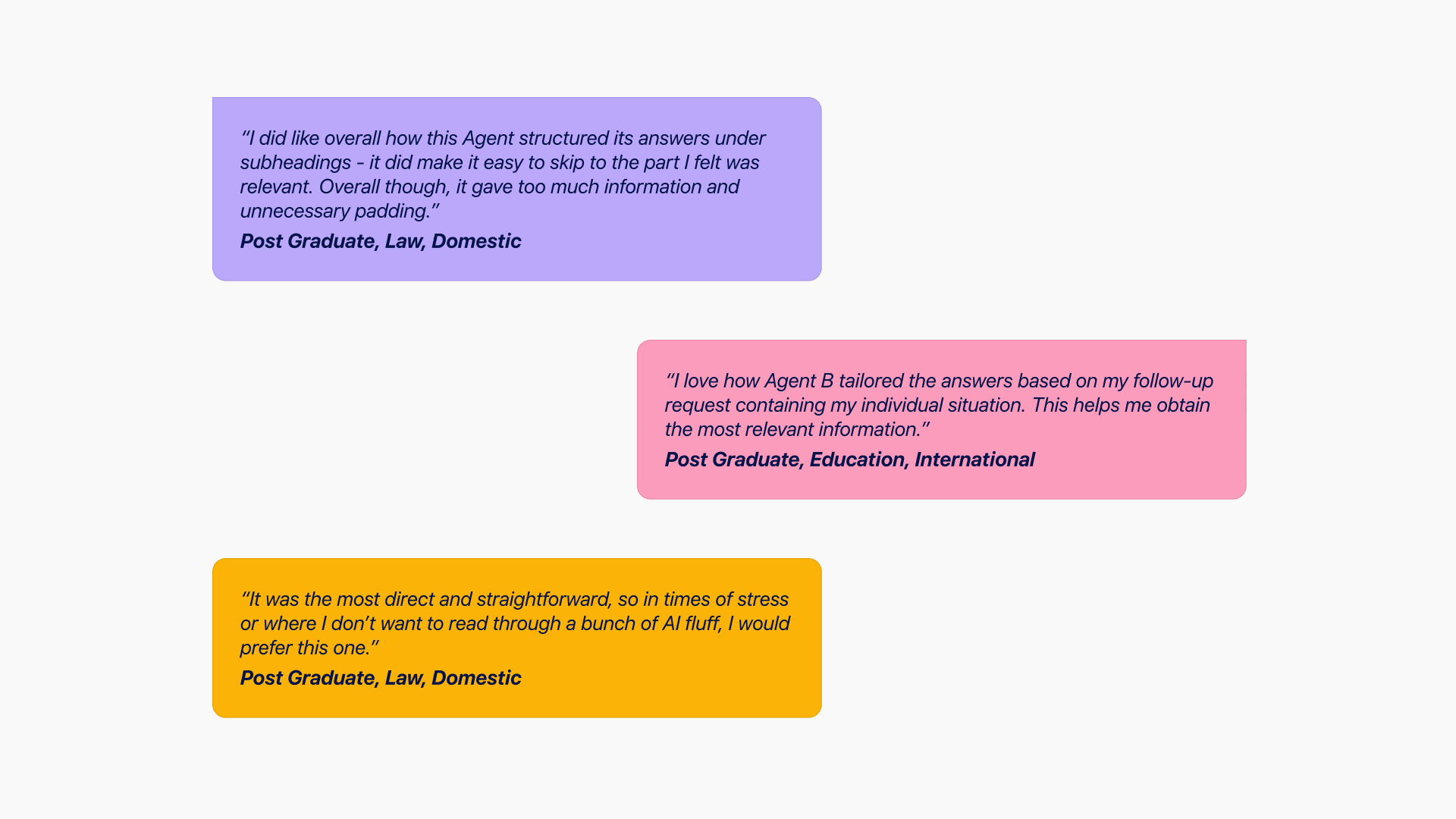
I led an experiment that involved cloning the existing AI assistant into three versions, each with a different behaviour. Students tested the versions through qualitative and quantitative research, using strategically selected scenarios to explore how different behaviours affected their experience and ability to resolve enquiries.
Designing for continuous improvement
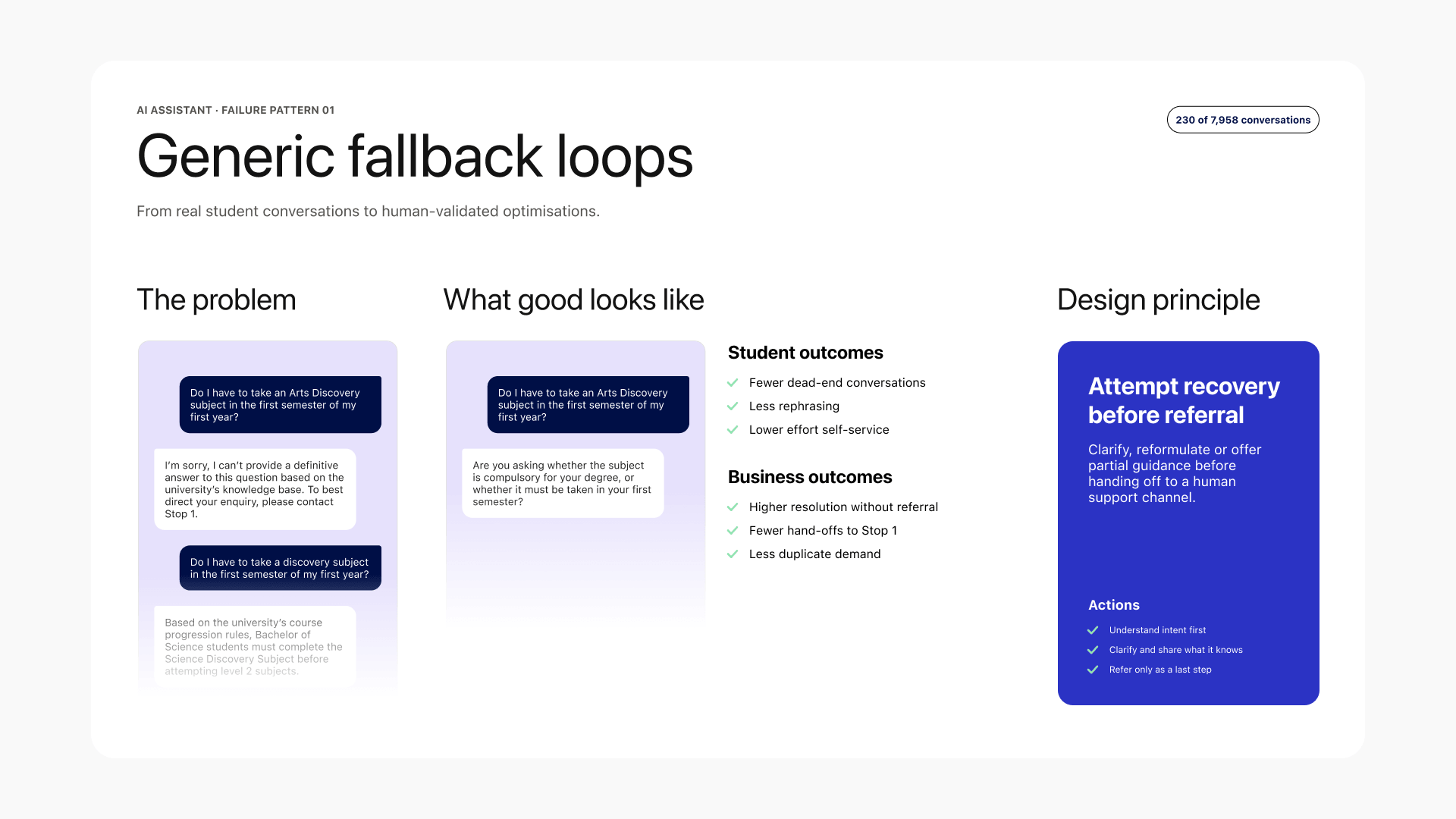
Launching the channel created an opportunity to learn from real student conversations and identify where the experience fell short.
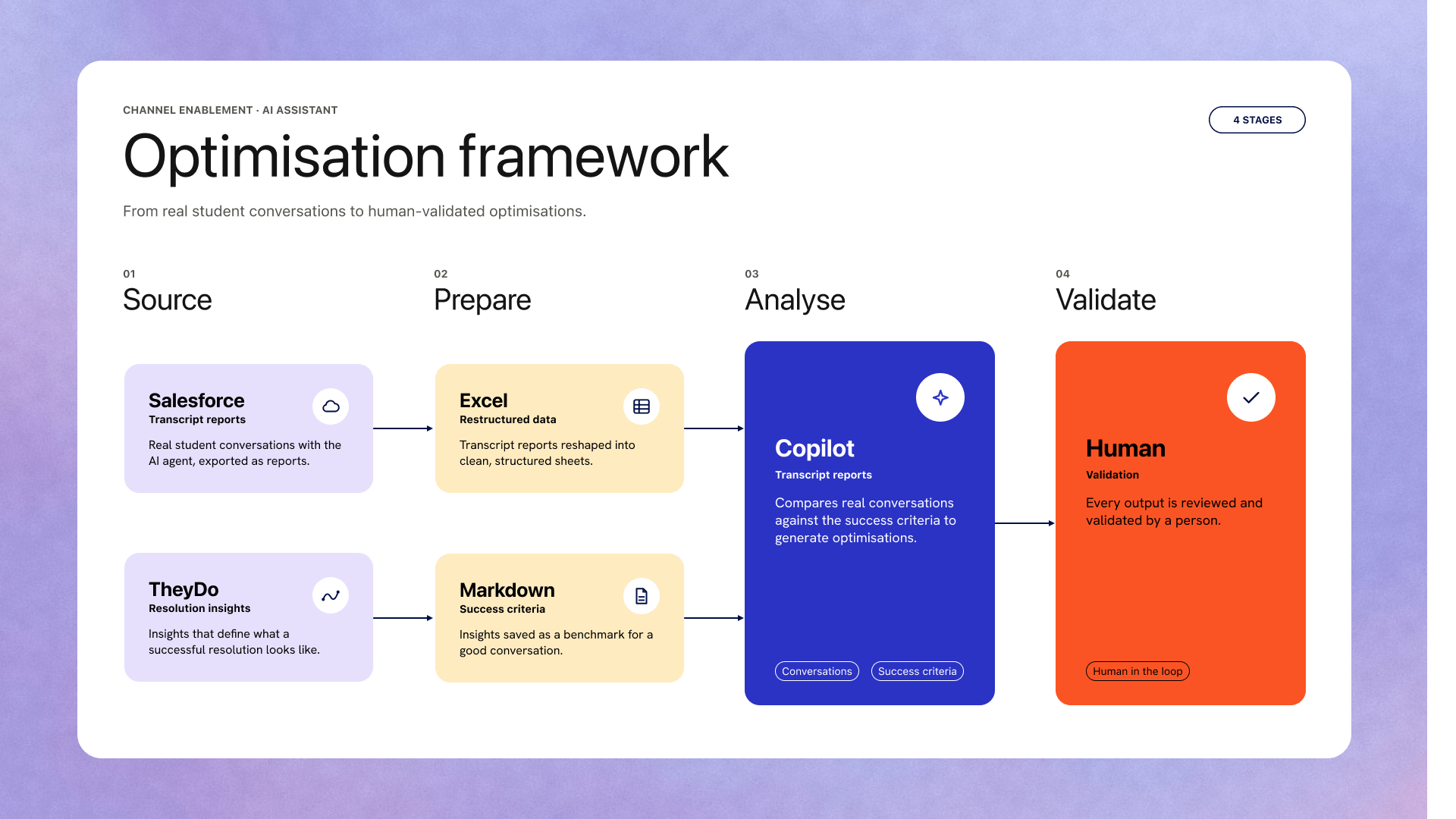
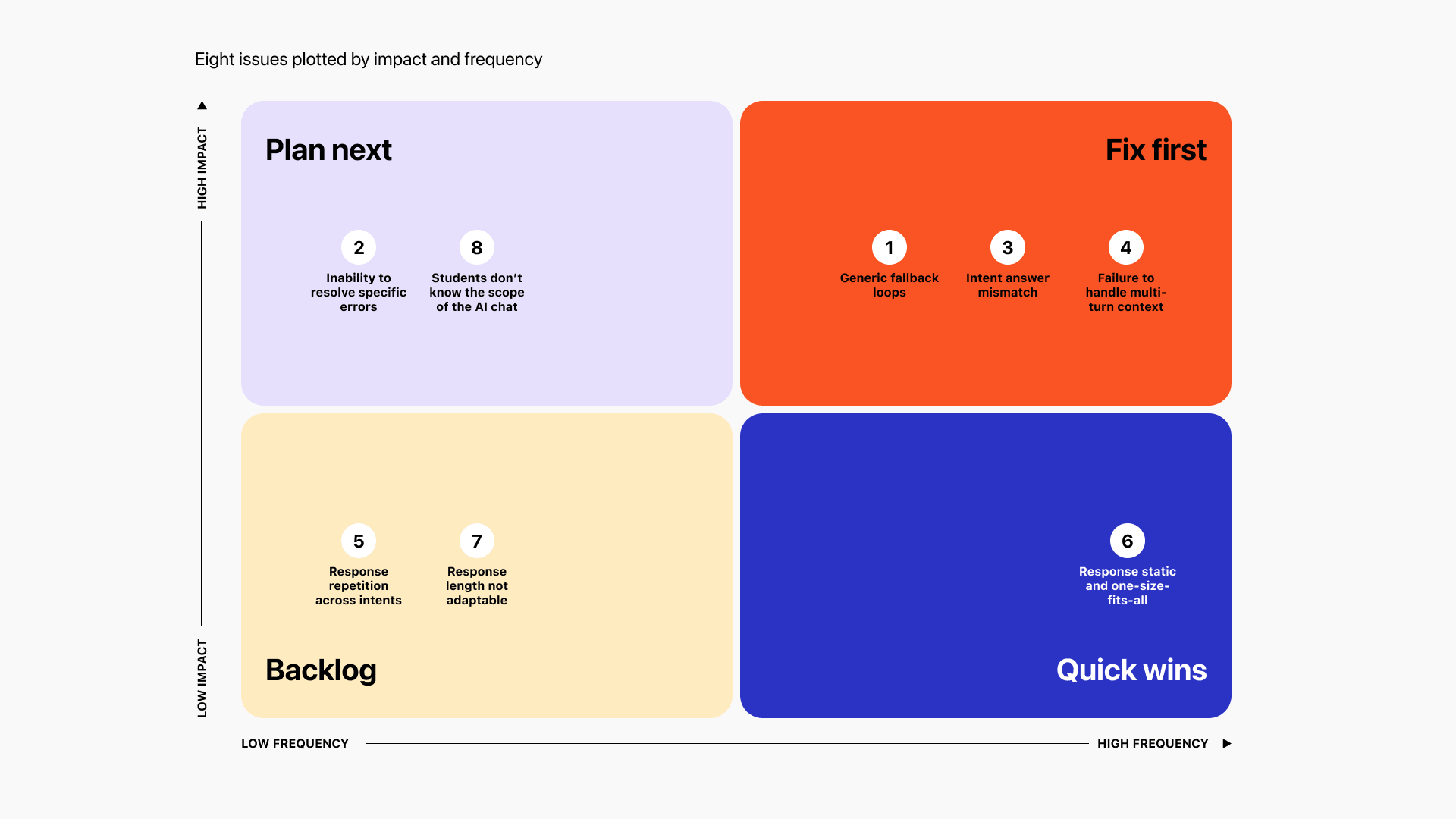
I developed an AI-assisted optimisation framework to help analyse conversation transcripts and surface recurring failure patterns. AI helped identify patterns, while human review provided context and informed decisions about what to improve.
Conversation data → AI-assisted analysis → Failure patterns → Human review → Design opportunities
The framework established a repeatable approach to identifying and prioritising improvements, creating a foundation for continuous optimisation as more data and feedback became available.
Building capability across the team
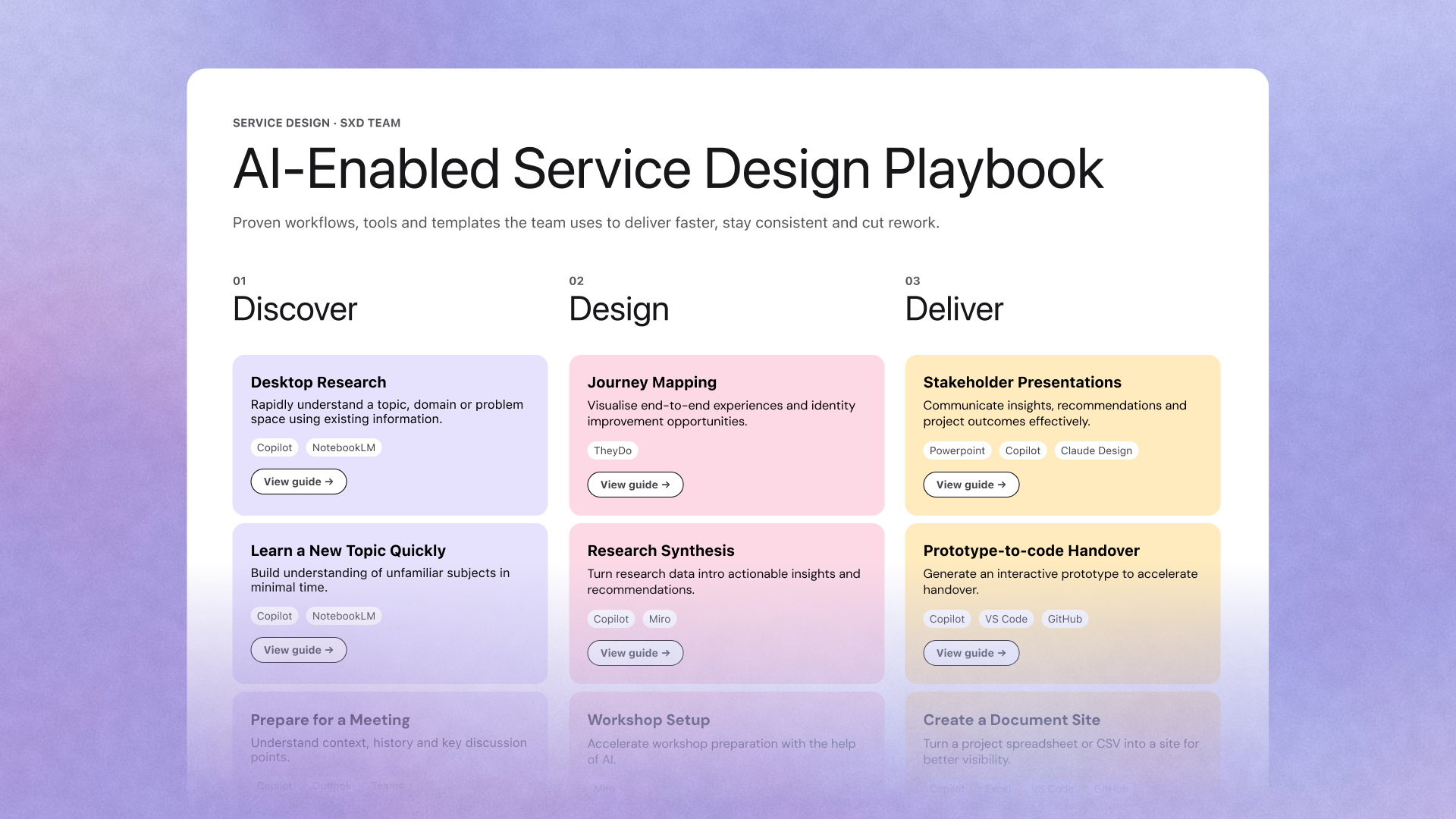
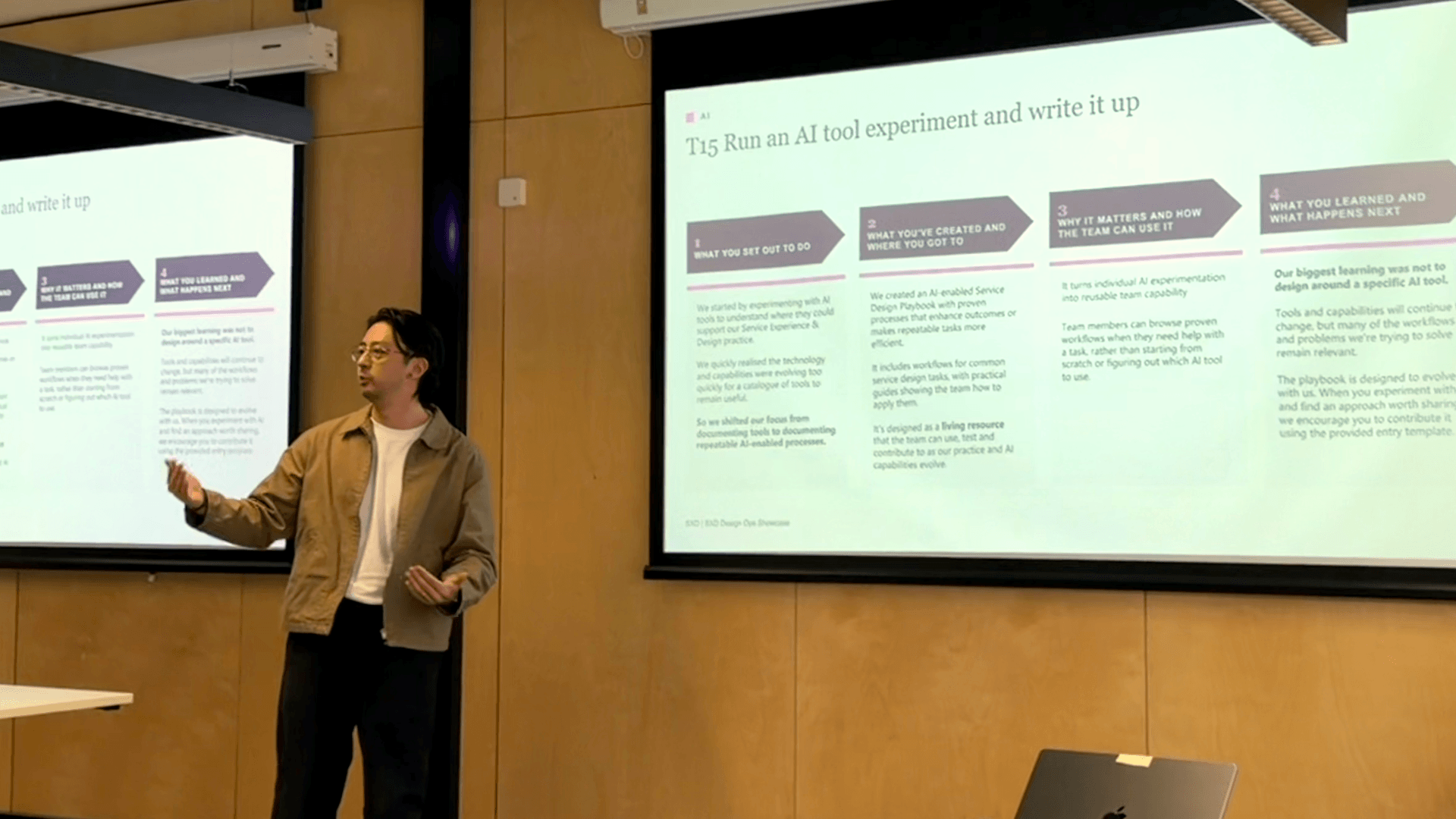
I mentored designers and documented and shared AI-enabled workflows, helping turn experimentation into reusable team practices.
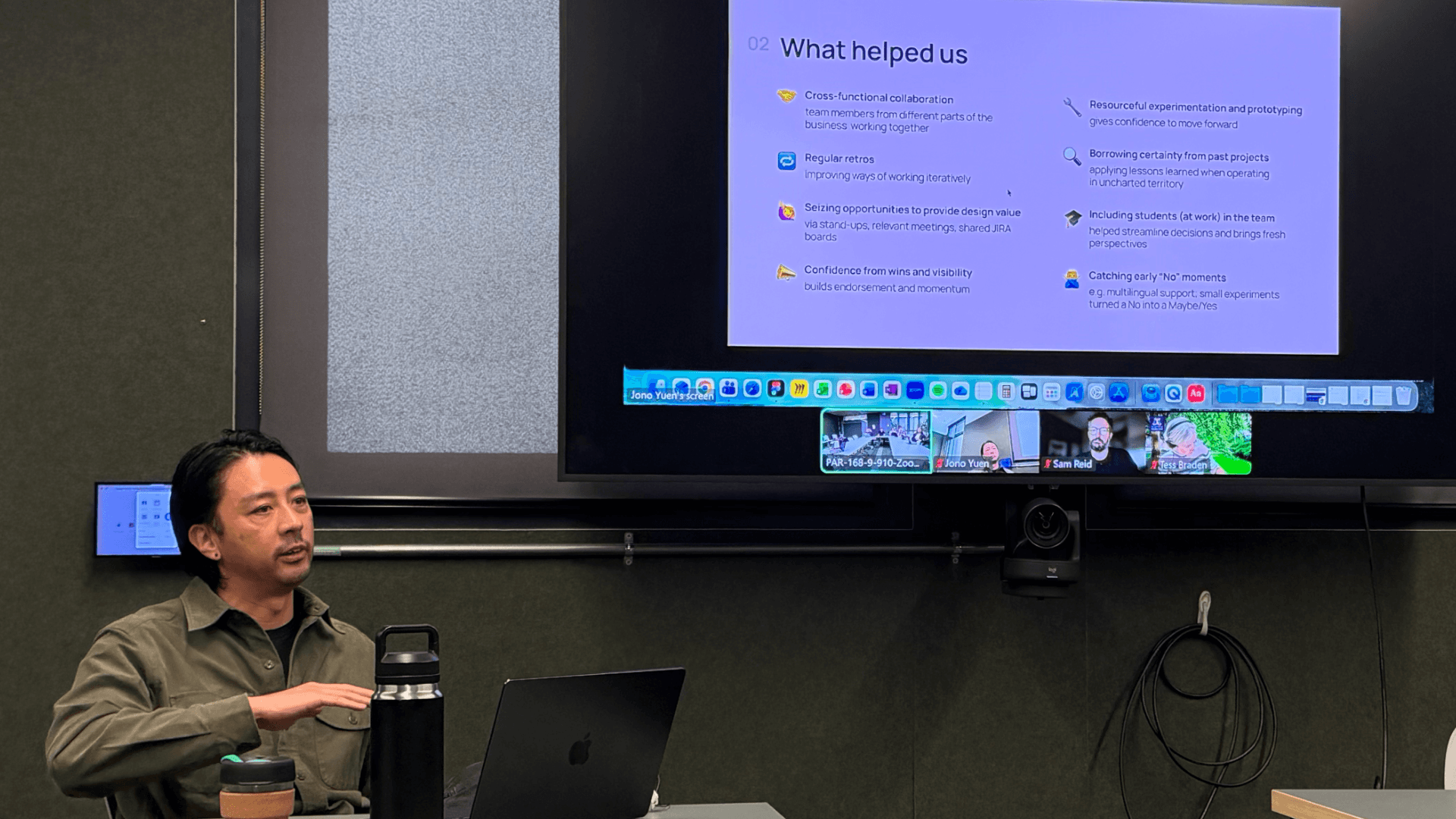
I also shared our work, methods and learnings across the University, extending knowledge of AI-enabled design beyond the immediate project team.
Results
The AI Student Support Channel launched in August 2025, becoming a significant part of the University's student support ecosystem.
24,441
Enquiries handled
(first 10 months)
87%
Resolution rate
Across 4,995 manually reviewed chats
53%
Outside opening hours
Extending access to support
19%
Reduction in webform volume
An indicator of potential operational impact
The work established a shared service direction, a research-led approach to exploring future capabilities, and a framework for continuous improvement. By combining student research with insights from real conversations, we created a foundation for the service to evolve in response to student needs.
“Great experience - I was able to resolve a query about subject withdrawal vs course deferral that will have a major positive impact on my studies and wellbeing.”
“Really easy to use and gave me the exact information I was looking for.”